
Fulton County Criminal Court Records
A criminal court record in Fulton County is the court's file for an adult criminal prosecution. It is broader than an arrest record. It can include the criminal complaint, formal information filed by the prosecutor, charge list, bail entries, arraignment events, motions, continuances, pleas, verdicts, sentence orders, fines, costs, restitution, and probation notes when those entries are public. The Fulton County Prothonotary and Clerk of Courts office is the local filing office for criminal cases bound over to the Court of Common Pleas, while civil matters use the Prothonotary name.
Fulton County is part of Pennsylvania's 39th Judicial District shared with Franklin County. The Court of Common Pleas handles felony cases, misdemeanor cases beyond summary jurisdiction, probation violations, summary appeals, juvenile matters, and other higher-level criminal proceedings. Fulton County's Magisterial District Courts handle many first-stage events, including preliminary arraignments, preliminary hearings, summary offenses, traffic matters, and warrants. That split matters because a Fulton County criminal court record may have an MDJ docket first and a common pleas docket later.
The local court table in the research places both the common pleas court and Magisterial District Court at the courthouse address, but their records are not interchangeable. A summary offense or preliminary hearing can remain an MDJ record. A felony case that is held for court becomes a common pleas criminal file. When the public docket shows both court levels, read the MDJ result as the first stage and the common pleas docket as the formal prosecution record.
The charge detail itself is treated separately from the full case file. For charge status, charging documents, and the arrest-to-charges path, use the Fulton County arrest records and charges page. For all court record types, including civil, family, Orphans' Court, and traffic files, use the broader Fulton County court records page.
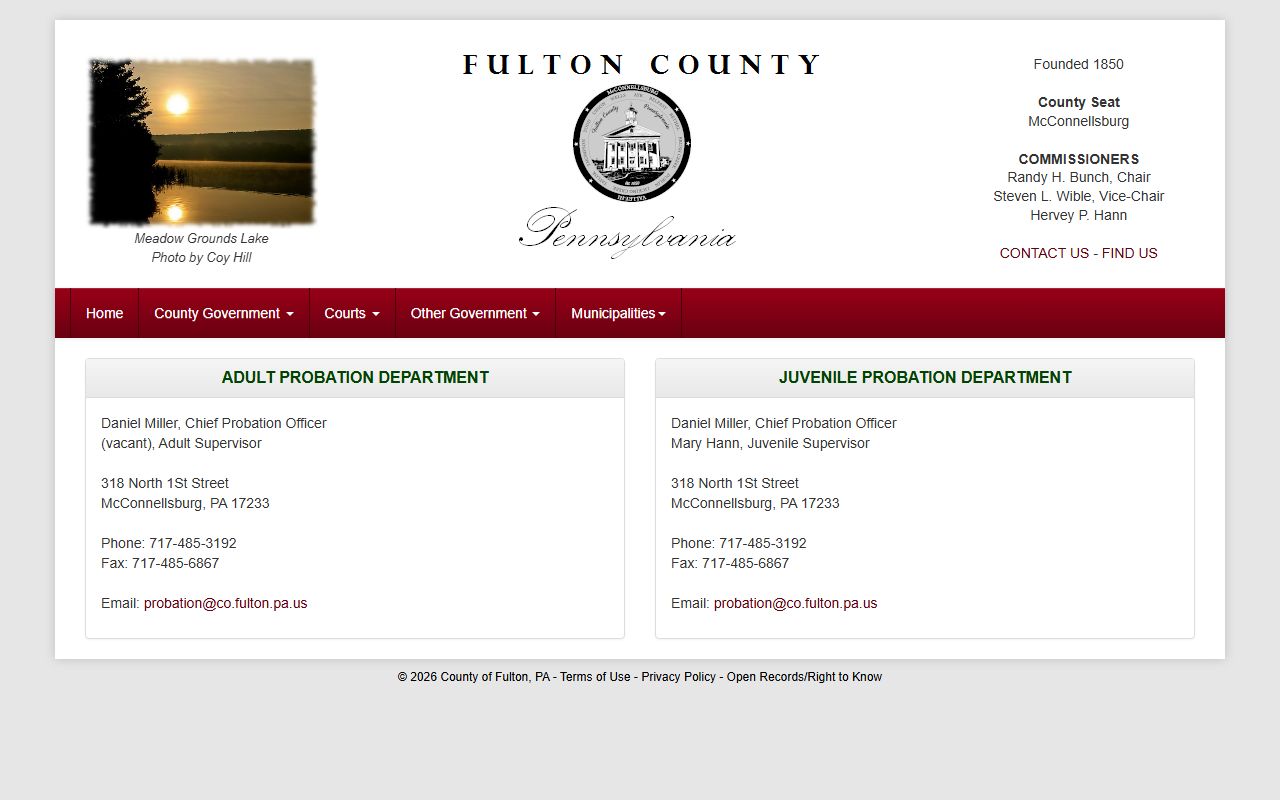
The Fulton County criminal court page uses the county's probation source as a local criminal-justice reference. The county Probation and Parole Office page describes supervision, fines, costs, restitution collection, drug testing, community service, and electronic monitoring. Those topics often appear after sentencing, so a probation entry can be part of the record story without being the same thing as a live custody roster.
Probation details help explain why a criminal docket may keep showing payments, hearings, or violation events after a plea or verdict has already resolved the charges.
Search Fulton County Criminal Records
Fulton County does not appear to publish a separate county-built criminal case database. Public case lookup starts with the Pennsylvania UJS Case Search and the docket-sheet tools for common pleas and magisterial district cases. Use the Court of Common Pleas route for felony and higher-level criminal files. Use the MDJ route for summary criminal matters, traffic citations, preliminary hearings, and early case events. Select Fulton County when a county filter is available so statewide name searches do not mix in unrelated defendants from other counties.
- Open UJS Case Search or the docket-sheet search for the correct court level.
- Choose Fulton County, then search by exact docket number if known.
- If the docket number is unknown, search by participant last name, first name, and a narrow filing date range.
- Open the docket sheet and check the caption, charges, docket entries, bail actions, case status, and disposition.
- Contact the Clerk of Courts for certified copies, older paper files, sealed-file questions, or documents not visible online.
The UJS docket is usually a text record, not a full packet of pleadings. If a docket lists an order, sentencing sheet, or motion but the image is not public online, the local office at the Fulton County Courthouse is the next step. For a paid official statewide criminal-history request, use Pennsylvania State Police PATCH. PATCH is not a substitute for the full court docket because it is a criminal-history request system, not a court-file viewer.
Fulton County Criminal Case Flow
Many Fulton County criminal matters begin at Magisterial District Court. An MDJ may handle a preliminary arraignment, set bail or release conditions, and hold a preliminary hearing to decide whether charges should move forward. If charges are held for court, the case proceeds to the Court of Common Pleas. The District Attorney then prosecutes the common pleas case, and the Clerk of Courts maintains the criminal docket and case filings.
Case flow: Charges Filed › Arraignment › Pretrial and Motions › Plea or Trial › Disposition › Sentencing.
| Stage | What the Fulton County Record May Show |
|---|---|
| Preliminary stage | MDJ docket number, complaint number, bail entry, hearing date, and held-for-court outcome. |
| Formal filing | Common pleas docket number, criminal information, offense tracking number, charge grade, and statute section. |
| Pretrial and motions | Continuances, motions, orders, attorney entries, notices, and hearing dates. |
| Plea or trial | Guilty plea, not guilty finding, verdict, withdrawal, dismissal, or other charge result. |
| Sentencing | Sentence terms, fines, costs, restitution, probation, confinement, and later violation entries where public. |
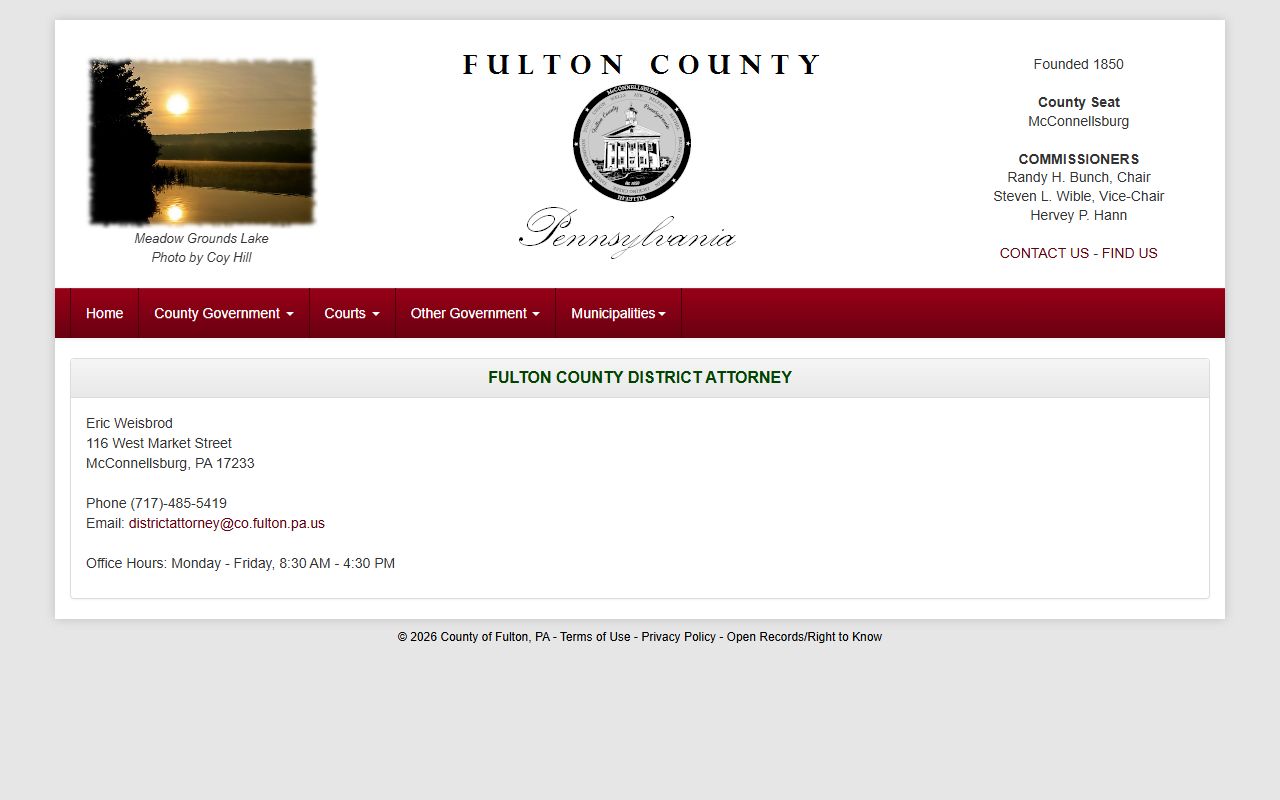
According to the Fulton County District Attorney page, Hon. Eric Weisbrod is the county prosecutor. The DA's role is not to keep the court record counter, but the office's filings and charging decisions shape what appears in the criminal docket.
Fulton County Criminal Record Fields
A public docket sheet can be enough to confirm the basic status of a Fulton County criminal case. It can also be easy to misread. The caption names the parties, but it does not prove guilt. The charge list can include dismissed or amended counts. The event log may contain short docket text instead of the full order. The financial section may show costs or restitution, but a balance does not always describe all sentence terms.
| Field | What It Shows |
|---|---|
| Docket number | The unique court case number for the common pleas or MDJ record. |
| Caption | Commonwealth v. defendant, county, court level, filing date, and case status. |
| Charges | Offense name, statute, grade, offense date, disposition, and sentence where entered. |
| Attorneys | Counsel of record for the Commonwealth and defendant when public. |
| Docket entries | Filings, notices, orders, hearings, continuances, plea events, and sentencing entries. |
| Financials | Fines, court costs, restitution, payment plans, and balances when available for public view. |
The public UJS docket normally redacts Social Security numbers, financial account numbers, minor identifiers, victim details, and protected addresses. A reader who needs a certified sentencing order, a full order, or a non-public file component should contact the Clerk of Courts rather than rely on screenshots or copied docket text.
Fulton County Charges vs Convictions
A charge is an allegation. A conviction is a final outcome based on a guilty plea, verdict, or other conviction event. Fulton County criminal records may show both, but they must not be read as the same thing. A docket can list an original charge that was later reduced, amended, withdrawn, dismissed, or resolved by plea to a different count. Always read the disposition next to each charge before treating it as an outcome.
| Point | Charge | Conviction |
|---|---|---|
| Meaning | An alleged offense filed in court. | A charge result based on a plea, verdict, or finding. |
| Timing | Appears early in the docket. | Appears after disposition or sentencing. |
| Record risk | May be pending, amended, dismissed, or withdrawn. | May carry sentence, costs, probation, or restitution. |
The official source image for 18 Pa.C.S. Section 9122 is tied to expungement, which becomes relevant when a person is checking whether an old criminal record can be removed from public access.
Expungement should be checked against the exact docket and charge outcome because Pennsylvania eligibility depends on the case category, result, sentence completion, and later record history.
Fulton County Sealed Criminal Records
Pennsylvania uses both expungement and limited access. Expungement can remove qualifying criminal-history record information under 18 Pa.C.S. Section 9122. Clean Slate limited access under 18 Pa.C.S. Section 9122.1 can restrict eligible records from ordinary public view. The two are related, but not identical. Neither should be promised for all old, dismissed, or low-level cases.
| Point | Limited Access | Expungement |
|---|---|---|
| Public view | Record is hidden from many public searches. | Qualifying record information is removed or destroyed as ordered. |
| Use in court | Certain justice agencies may still have access. | Access is narrower and depends on the order and law. |
| How to start | May be automated for eligible Clean Slate records or petition-based. | Usually requires checking eligibility and filing in the court that handled the case. |
The official source image for 18 Pa.C.S. Section 9122.1 reflects Pennsylvania's Clean Slate limited-access law, which can affect whether an older Fulton County criminal record still appears in a public search.
Limited access does not mean every agency copy vanishes. It means ordinary public access may be blocked under the statute or a court order.
Restricted Fulton County Criminal Records
Some Fulton County criminal record material is not public through ordinary docket searches. Juvenile files are restricted under 42 Pa.C.S. Section 6307. Mental health proceedings, protected identifiers, victim information, confidential addresses, sealed filings, and certain abuse-related details are also withheld or redacted. An entry may confirm that a case exists while still hiding sensitive documents.
Use the Pennsylvania court public-records policies for judiciary records. The Pennsylvania Office of Open Records and the Right-to-Know Law are more useful for non-court county agency records. That distinction is important in Fulton County because sheriff administrative records, court dockets, and criminal case files do not all follow the same request path.
Public-defender appointment information was not confirmed on an official Fulton County Public Defender page during research. If a criminal docket shows counsel questions, appointment events, or a need for representation, confirm the current process through the Court of Common Pleas, Magisterial District Court, or courthouse. Do not use private attorney directories as a substitute for a court-confirmed public-defender appointment path.
Note: For common pleas criminal copies, use the Clerk of Courts, not the Prothonotary's civil-record function.